
Business Transformation Labs (BTLs) are a structured, evidence-driven co-creation process to strengthen the performance and resilience of land-based investments.
Land-based investments often face operational challenges that are not primarily technical in nature. Instead, they stem from weak communication, fragmented coordination, unclear roles, and limited alignment between companies, communities and government. These dynamics can affect supply reliability, labour stability, regulatory processes and overall business performance.
BTLs address these challenges by creating a structured space for joint diagnosis and action planning. Rather than introducing external solutions, they bring together companies, communities and government actors to develop a shared understanding of how the business operates in practice and where improvements are needed.
"After the workshop, our relationship with surrounding villages is stronger. Problems that used to take months are now resolved in days.”
"The BTL process surfaced these dynamics explicitly, linking livelihood insecurity to operational instability."
"This is the first time we have been able to discuss our challenges openly with communities and government in the same room.”
How BTLs work
BTLs follow a structured, phased process that helps companies move from understanding their operating context to agreeing and acting on practical, jointly owned solutions. The process is designed to support informed decision-making, reduce risk and strengthen business performance in complex operating environments.
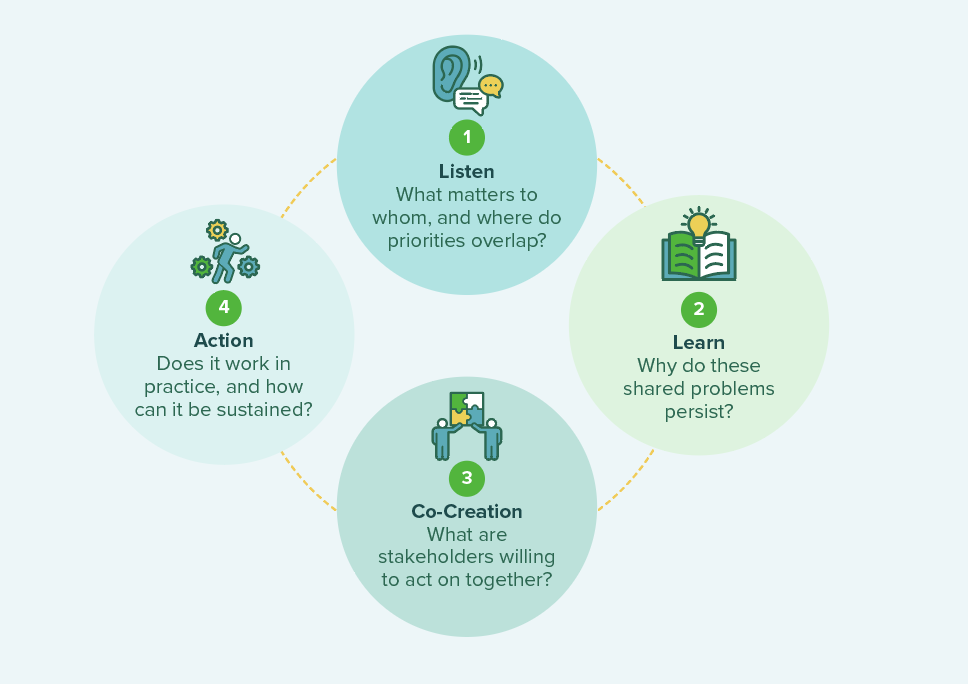
At the core of the BTL approach is co-creation, but co-creation does not stand alone. It is grounded in careful listening and shared learning, and followed by action and adaptation over time. Together, these phases ensure that dialogue is informed by evidence, that solutions are realistic and commercially relevant, and that commitments can be carried forward into day-to-day business practice.
While presented as a sequence, the phases are iterative. Insights gained through action often prompt renewed listening and learning, allowing companies and stakeholders to adapt as conditions change.
The BTL process is organized around four connected phases:
What BTLs produce
The BTL process results in:
- A shared understanding of operational challenges and their root causes
- Practical, time-bound action plans jointly developed and owned by stakeholders
- Strengthened coordination mechanisms between companies, communities and government
- Clear pathways for implementation within existing business and institutional systems