

Business Transformation Labs in action
Business Transformation Labs (BTLs) are a structured, evidence-driven co-creation process used by the TLI programme to strengthen the performance and resilience of land-based investments. By bringing together companies, communities, and governments, TLI identifies shared priorities – the innovation space where divergent interests converge into practical, win-win solutions.
Between 2022 and 2025, the TLI programme implemented 20 BTLs across Ethiopia, Ghana, Mozambique, Myanmar and Laos, covering commodities from cocoa, rubber and timber to maize, cassava and horticulture. Despite differences in scale — from large export plantations to smallholder contract farming systems — similar operational bottlenecks emerged. These were rarely technical in nature. Instead, they reflected weak communication, fragmented coordination and exclusion from decision-making processes.
The BTL process did not introduce external solutions. It created a structured space for joint diagnosis and action planning, allowing companies, communities and government actors to address these bottlenecks collectively.
After the workshop, our relationship with surrounding villages is stronger. Problems that used to take months are now resolved in days.
— Company Representative, Ghana
Turning communication gaps into structured business operations
Weak, ad hoc or opaque communication was the most common bottleneck across BTLs. What made this finding striking was that in most cases, the underlying problem was not disagreement or bad faith, it was information asymmetry. Farmers did not know when buyers would come. Workers did not understand recruitment criteria. Communities could not access pricing information. Companies faced inconsistent supply without understanding why. The result in each case was the same: mistrust, avoidable friction and escalating costs that no single party had intended or could resolve alone.
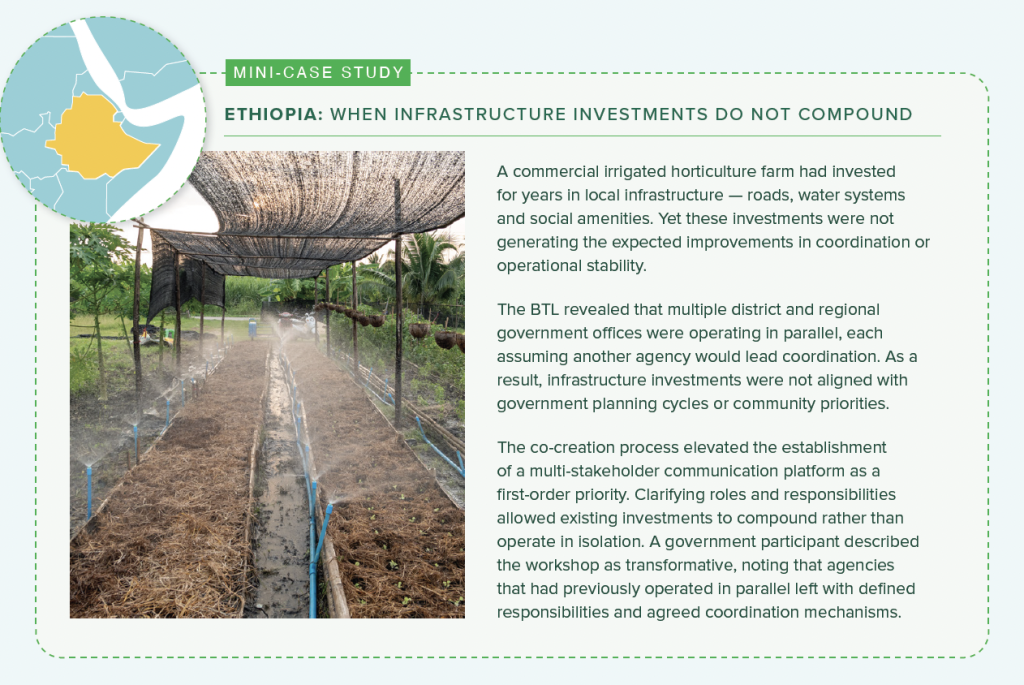
What the BTLs demonstrated is that these are not intractable problems. In Mozambique, standing company–community committees with elected membership and written mandates replaced reactive, issue-by-issue engagement. In Laos, publicly posted purchase schedules and digital information-sharing platforms addressed a cycle in which farmers could not plan production, and companies could not plan supply — each side interpreting the other’s behaviour as unreliable rather than uninformed. In Ethiopia, a company’s rapid expansion had outpaced its communication structures; the BTL created pathways to ensure that community members had access to information about opportunities that were, in principle, open to them. None of these solutions required significant capital investment. What they required was the willingness to treat communication as infrastructure; something to be deliberately designed and maintained, not assumed.
Reframing technical assistance as supply chain investment
Limited access to agronomy support, pest and disease management and quality control was repeatedly identified as a core business risk. Where smallholders lacked technical support, yields were lower, quality was inconsistent and supply was unreliable. Companies were informally absorbing these costs through ad hoc training and input provision, or managing the consequences through higher procurement costs and supply volatility.
The BTL response in each case was to reframe technical assistance not as charity but as supply chain investment. In Laos, the co-created action plan established a pathway toward dedicated cassava learning centres, embedding training within government extension structures to reduce company burden over time. In Ethiopia, skills transfer programmes were redesigned to include community members who had previously been excluded, with explicit attention to women and youth as target beneficiaries — not for equity reasons alone, but because expanding the skilled labour pool directly addressed a company’s workforce and supply constraints. In Mozambique, government extension services were identified as underutilized partners whose involvement could reduce costs for companies while building long-term community capacity.
Where technical assistance was treated as a shared investment rather than a company obligation, it generated returns for all parties.