
Business Transformation Labs
Land-based investment in agriculture and forestry often succeeds technically but struggles operationally when coordination breaks down: unclear expectations, weak information flows, mistrust between parties, and misalignment between companies, communities and government.
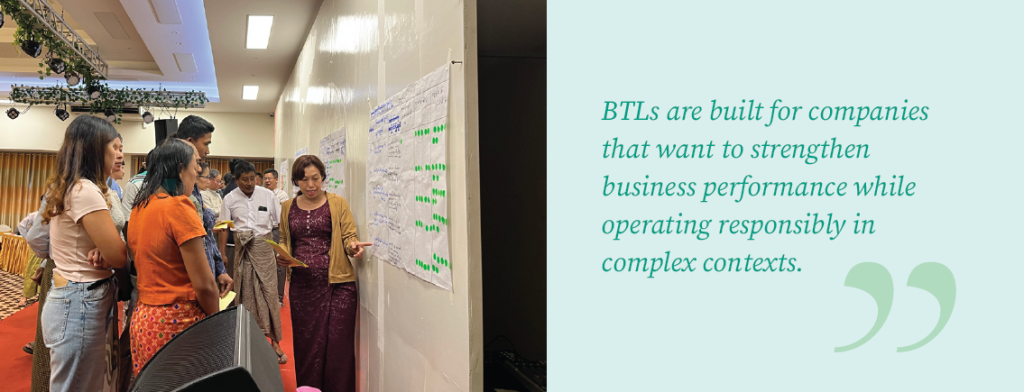
Business Transformation Labs (BTLs) are a structured co-design method that helps agribusinesses and forestry companies address these challenges as business risks — and convert them into practical operational improvements. BTLs are built for companies that want to strengthen business performance while operating responsibly in complex contexts.
What BTLs focus on
BTLs examine how value is created, sustained or constrained across operation contexts.
- Relationships between companies, producers, communities and authorities
- Decision-making processes and information flows
- Supply chain dynamics
- Environmental, Social, and Governance practices
Rather than responding to issues only after they escalate, BTLs help companies understand how their operating system functions — and where adjustments can improve performance and reduce risk.
This approach is not about adding parallel social initiatives. It is about ensuring resilient business models operating within their local context.
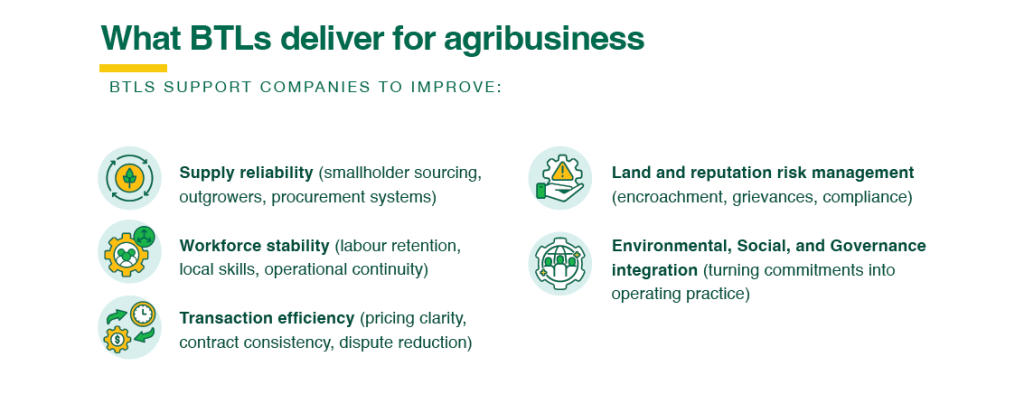
How BTLs work
An evidence-driven co-design process from insight to action
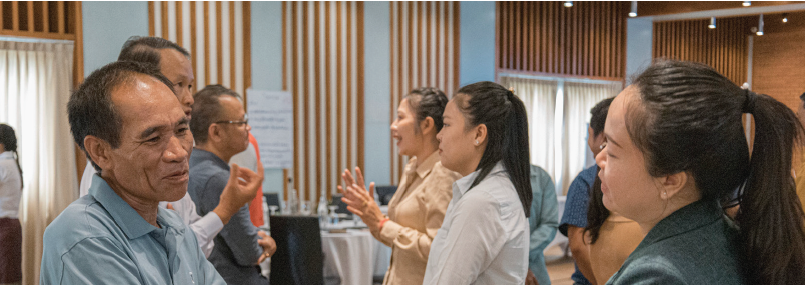
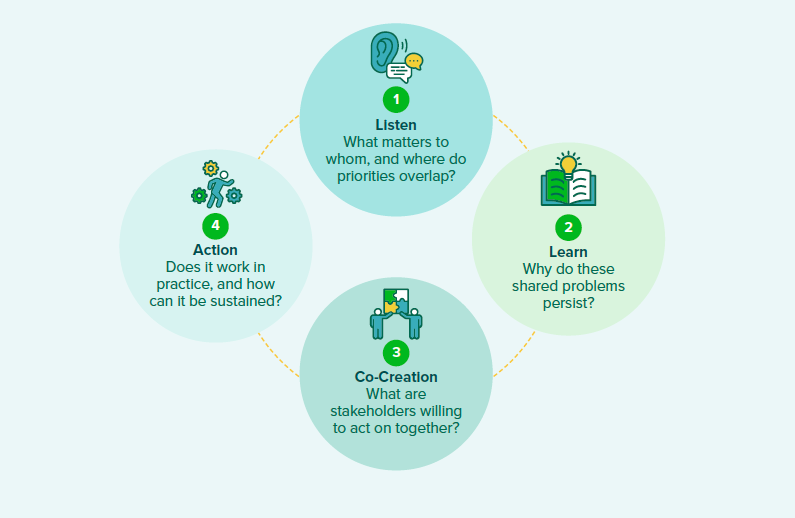
BTLs follow a structured, phased process that helps companies move from understanding their operating context to agreeing and acting on practical, jointly owned solutions. The process is designed to support informed decision-making, reduce risk and strengthen business performance in complex operating environments.
At the core of the BTL approach is co-creation, but cocreation does not stand alone. It is grounded in careful listening and shared learning, and followed by action and adaptation over time. Together, these phases ensure that dialogue is informed by evidence, that solutions are realistic and commercially relevant, and that commitments can be carried forward into day-today business practice.
While presented as a sequence, the phases are iterative. Insights gained through action often prompt renewed listening and learning, allowing companies and stakeholders to adapt as conditions change.
The BTL process is organized around four connected phases:
Find out more: