
Strengthening sustainability in Lao agriculture: aligning LaoGAP with agroecology
Across Lao PDR, agriculture is more than an economic sector – it is the backbone of rural life. Over 70% of the population relies on farming for income and food security, and smallholders remain the country’s most important investors in land, labour and production. As Laos continues its transition toward greener, more competitive agriculture, an important question is emerging:
How can farmers, markets and policy frameworks evolve together to support safer, cleaner, more sustainable food systems – without leaving smallholders behind?
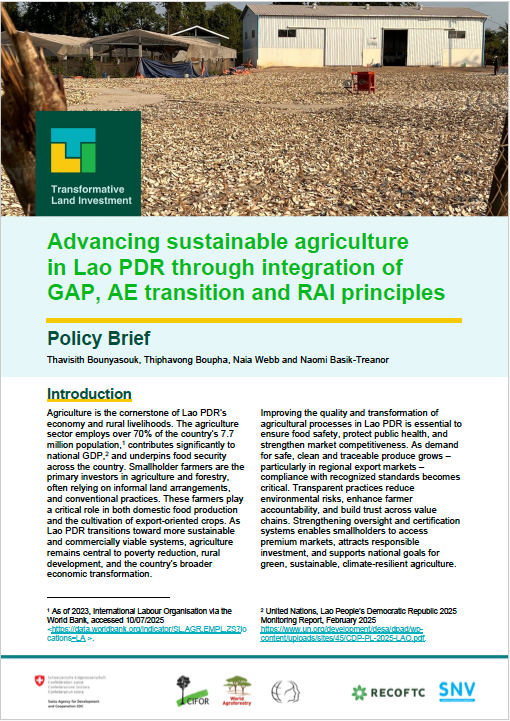
A new Transformative Land Investment (TLI) policy brief argues that one of the most powerful opportunities lies in aligning two existing systems of practice and regulation:
🔹 LaoGAP – the national framework that guides safe, high-quality agricultural production, with standards for traceability, certification and market access.
🔹 ASEAN Agroecology Guidelines (AE) – a broader, transformational framework for building climate-resilient, socially inclusive and ecologically sound food systems.
Individually, each offers something valuable. Together, they could help Laos unlock resilient growth at scale.
Why alignment matters now
Global and regional markets – especially China – are increasingly demanding agricultural products that are traceable, safe and demonstrably sustainable. China already requires GAP certification for key agricultural imports, yet many Lao farmers struggle to meet existing LaoGAP requirements due to the cost, training needs and institutional challenges involved in certification.
At the same time, agroecology is gaining traction across ASEAN for its potential to rebuild soils, reduce chemical dependency, lower input costs, strengthen biodiversity and empower farmers. But agroecology alone does not guarantee market access or certification.
Integrating LaoGAP, AE and ASEAN Responsible Agricultural Investment (RAI) principles could close this gap – supporting farmers not just to produce sustainably, but to earn more from doing so.
What would this look like in practice?
The brief identifies five strategic pathways for integration – each offering a practical entry point for policymakers and development partners:
🌱 1. Align policy and standards across ministries
Joint policy development can reduce overlap, streamline implementation and strengthen regulatory clarity. This includes embedding agroecological principles into LaoGAP modules on environment, worker safety, and food quality.
📜 2. Harmonise certification systems
Updating LaoGAP to fully reflect ASEAN GAP requirements – particularly environmental management criteria – would help position Lao products more competitively in premium markets.
👩🏽🌾 3. Build capacity from farm to ministry level
Extension services, training and digital knowledge-sharing platforms are critical. Without strong support systems, smallholders will continue to face barriers to compliance.
💰 4. Mobilise investment and incentives
Adoption takes resources. Green finance instruments, tax incentives, participatory guarantee systems and low-interest loans could help reduce risk for farmers transitioning to new standards.
📦 5. Strengthen market access strategies
Linking certified producers to domestic, regional and international markets – particularly China – will ensure that sustainability leads to real, tangible income benefits.
The opportunity ahead for Lao PDR
Laos stands at a pivotal moment. Significant policy planning is already underway – through the National Agroecology Transition Action Plan, Investment Promotion Law, National Crop Policy, and LaoGAP implementation efforts. The building blocks are there. What is needed now is coherence, integration and long-term commitment.
If the country succeeds in harmonising standards and scaling support for farmers, the benefits could be transformational:
✔ stronger export competitiveness
✔ healthier soils, ecosystems and biodiversity
✔ safer food systems
✔ more inclusive rural economies
✔ long-term resilience to climate and market shocks
In short: better agriculture, better livelihoods, and better landscapes.